
Some of the most common questions people search over internet are-
- What is the difference between Juicing and Blending?
- Which one is better?
- Does one offer more health benefits than the other?
Well be a little bit patient and I hope all your doubts will be cleared by the end of this article.
First thing first, in order to know the difference between juicing and blending we should start our discussion with the meaning of these two terms because very often I found that when somebody is referring juicing what he/she actually means is blending. So I think this is extremely important for us to know what Juicing and Blending are all about.
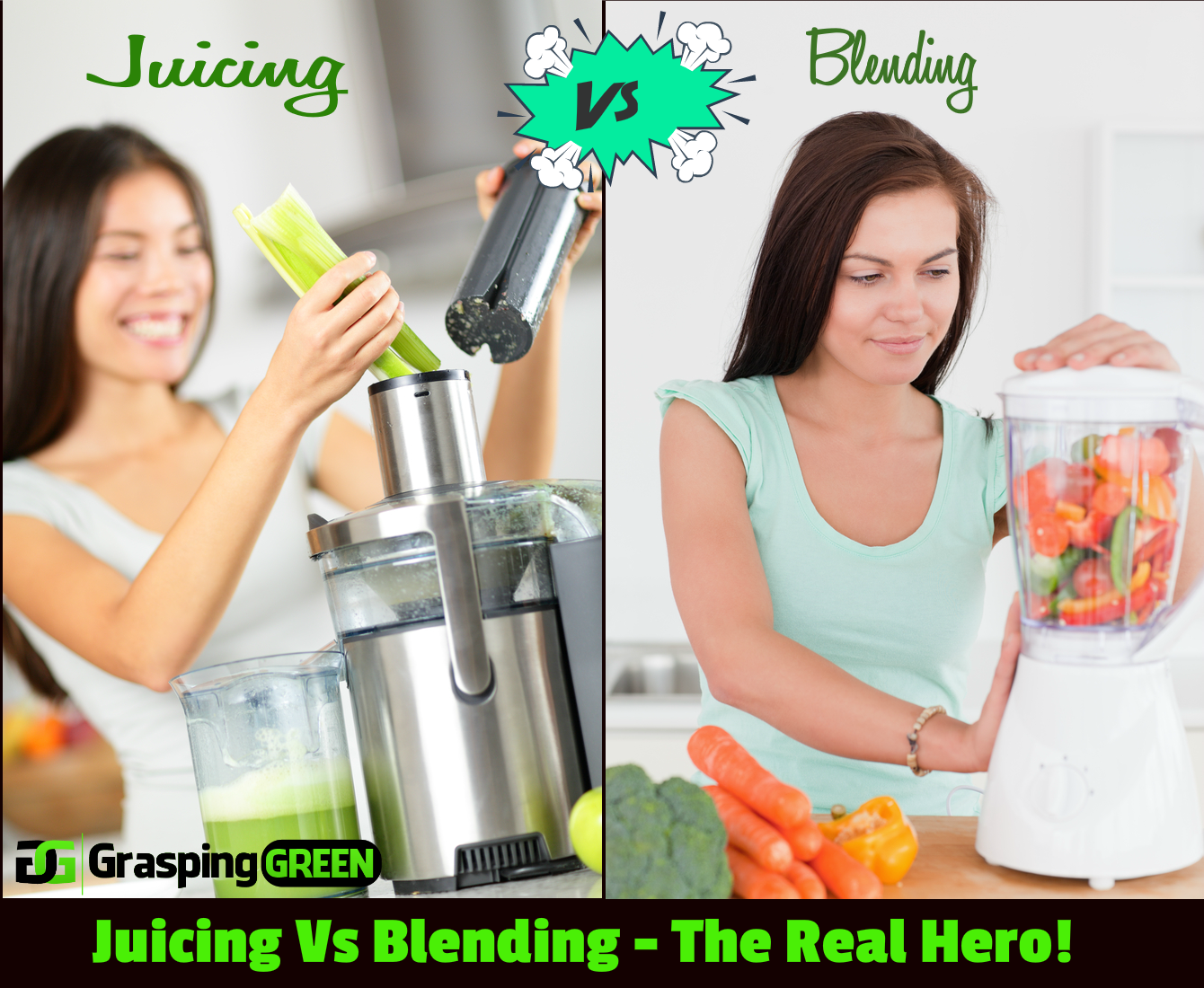
What Is Juicing?
Juicing is a process which extracts water and nutrients from produce and discards the indigestible fiber or pulp.
Without all the fiber, your digestive system doesn’t have to work as hard to break down the food and absorb the nutrients. In fact, it makes the nutrients more readily available to the body in much larger quantities than if you were to eat the fruits and vegetables whole.
This is especially helpful if you have a sensitive digestive system or illness that inhibits your body from processing fiber. The fiber in produce helps slow down the digestive process and provides a steady release of nutrients into the blood stream. Jason Vale calls juicing “A nutrient express!”
Freshly squeezed vegetable juices form part of most healing and detoxification programs because they are so nutrient rich and nourish and restore the body at a cellular level.
Words of caution:
- Removal of fiber: When you remove the fiber from the produce, the liquid juice is absorbed into your blood stream quickly. If you are only juicing fruits, this would cause a rapid spike in blood sugar and unstable blood sugar levels can lead to mood swings, energy loss, memory problems and more!
- Not a good appetite suppressant: Fiber is also filling and without fiber in the juice, some people tend to get hungry again quickly.
What Is Blending?
Unlike juices, smoothies consist of the entire entire fruit or vegetable, skin and all and contain all of the fiber from the vegetables.
However, the blending process breaks the fibre apart (which makes the fruit and vegetables easier to digest ) but also helps create a slow, even release of nutrients into the blood stream and avoids blood sugar spikes.
Smoothies tend to be more filling, because of the fiber, and generally faster to make than juice, so they can be great to drink first thing in the morning as your breakfast, or for snacks throughout the day.
By including the fiber in your smoothie, the volume will increase. Also, you can pack more servings of fruits and veggies into a single serving of juice than you can into a smoothie.
Words of caution:
- Risk of Calorie Overload. Most fruits and vegetables don’t have a lot of calories, but when you start adding Greek yogurt, peanut butter, oats, vanilla-flavoured soy milk, and half an avocado to your smoothie, the total calorie count escalates quickly. If you’re concerned about calorie intake, be careful about what you add to your smoothie, and watch your portion sizes closely.
- Risk of Sugar Overload. Like calorie-overload, sugar-overload is easy to come by when whipping up a smoothie. Added ingredients like yogurt and flavored milks may have a high sugar content. When combined with the sugars found in fruits and veggies, it’s easy for the sugar in a smoothie to skyrocket. Always check the sugar content in your added ingredients to make sure your intake remains low.
Now the next question that comes in your mind is : Which One Is Better?
Well, the answer is very simple… I love both!
There is no clear winner because both juicing and blending come with different benefits as they both help us to include a lot of fresh vegetables and fruits in our diet, and also to consume a greater variety than we may otherwise eat. It’s on your personal preference, your goals and your current state of health.
Let me explain the differences of juicing and blending so that it may clear your doubts about what to expect from these two and probably it will help you to decide which one you want to try.
| Juicing | Blending |
| 1) Extract the juices by separating the juice from the fiber/pulp. Result you get is pure, smooth juice. Pulp is separated. | Liquefy whole fruits/ vegetables by chopping them very finely with blades, spinning at very high speed. Result is a pulpy puree-like drink which you call a “smoothie”. During blending, air gets trapped in the drink, making it “fluffy”. The air, together with the pulp may cause gas/bloating in some people. |
| 2) Extract juices from moisture-rich fruits/vegetables. A masticating juicer can even extract juices from leafy vegetables. | Useful for liquefying low water content and non-judiciable fruits like banana, avocado, papaya and leafy vegetables. |
| 3) Juicing is about hydration, when you drink juices that supply your body with a high amount of liquid that is rich in vitamins, minerals, phytonutrients, enzymes, anti-oxidants, etc. It makes the cells happy. | With blending, there will be less hydration compared to juicing, as there is high fiber in the drink. |
| 4) No energy needed to digest pure juice. Energy is conserved for cleansing work, especially useful when doing a juice cleanse. | More energy/enzymes are being expended in your body, to digest the fiber. |
| 5) Vegetables may taste better when extracted using a masticating juicer. The pressing method makes the green juice tastes better. You can also add one or two fruits, or herbs to enhance the taste of your juice. | Green leafy vegetables may tend to taste “grassy” and unpalatable. You can add in powders, granules, nuts, seeds, ice cubes, spices, herbs, etc. to improve the taste of the smoothie. |
| 6) There is no fiber. You drink the juices and there is very little effort by the body to immediately assimilate the vitamins/minerals from the juices and distribute to the cells immediately for nourishment and healing. This is the exact reason for drinking juices, to get the most nutrients (up to 99% absorption) out of the vitamins and minerals. | You get the fiber to be included in your drink. To your body, this is like eating your fruits/vegetables. Different enzymes are produced to extract the vitamins/minerals and they have to get through the fiber to get to the “trapped” nutrients. It takes more effort for nutrient absorption and less nutrients are being assimilated in the process. If your digestive system is good, you probably get only up to about 35% absorption of the vitamins and minerals. |
| 7) With juicing, it’s not about the fiber, it’s about HEALING. The reason we juice is about getting the optimum nutrition into our cells directly, and quickly. You get fiber from eating your fruits/ vegetables. | But we need the fiber? Yes, we need the fiber but that’s mostly what blending gives you—fiber, and less nutrients absorption. You could get fiber from eating your fruits/ vegetables too. So you decide, which is more important for you, fiber or nutrients. |
| 8) Pure juice is best made by including more fresh green vegetables for its best healing purposes. Due to its very high absorption rate, healing reactions are common and inevitable. | A fibrous drink means less sugar spike, and less healing reactions when doing a rawfood cleanse. When you blend, you do tend to eat more fruits/vegetables, which will also contribute to healing, but at a slower pace when compared to healing through drinking juices. |
| 9) With juicing, your body gets maximum amount of nutrients from a wider variety of fruits/ vegetables. You don’t feel full so quickly so you can drink more. Again, this is for the purpose of speeding up your HEALING. | With blending, you feel full very quickly due to the pulpy drink. If that’s your intention for blending, then that’s good. But this also means that you eat less fruits/vegetables a day and not obtain the optimum level of nutrients needed by your body. |
I hope this discussion will shed some light on the Juicing and Blending duel.
Source:
http://foodmatters.tv/articles-1/juicing-vs-blending-which-one-is-better
http://www.moneycrashers.com/juicing-vs-blending-smoothies-pros-cons/


